
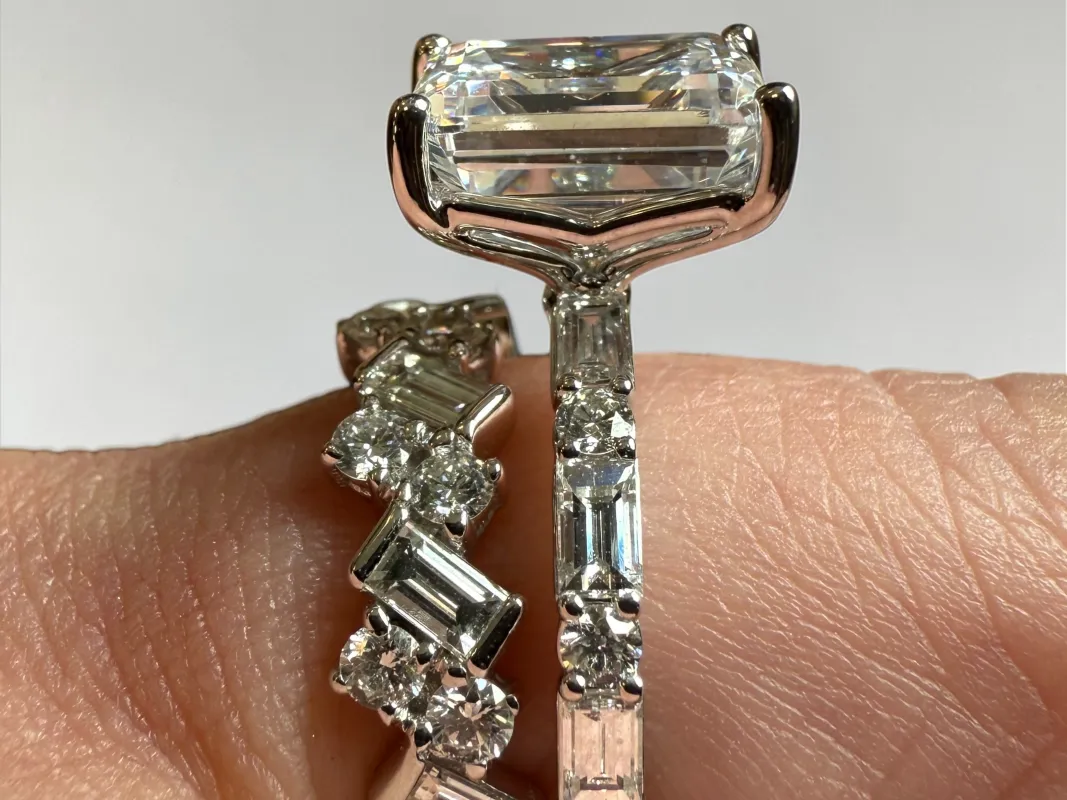
The setting is the metal framework that holds the diamond in an engagement ring, and it's one of the most important decisions you'll make. The setting you choose affects how the diamond looks, how the ring wears over time, and whether it suits your partner's lifestyle and personal style.
This guide covers the main types of engagement ring settings, what each one is best for, and the questions you should be working through before you make a decision. If you want to see these settings in person, the team at Hannoush Jewelers has showrooms in Albany, Clifton Park, and Queensbury, NY, with a GIA Graduate Gemologist on staff to help you work through every option.
Different settings expose different amounts of the diamond to light, which directly affects how the stone appears. Settings also vary significantly in how much they protect the diamond from everyday wear.
Four-prong settings give the ring a square orientation and expose more of the diamond. Six-prong settings provide more security and create a rounder outline, which suits round brilliant diamonds especially well.
Bezel settings have a sleek, modern aesthetic and are particularly well-suited to partners with active jobs or lifestyles. A full bezel encircles the stone completely; a partial (semi) bezel leaves the sides open.
Double halos add a second ring of accent diamonds around the first. Hidden halos place accent diamonds underneath the center stone, visible from the side but not the top.
Pavé is typically used on the shank of a ring rather than as the primary setting for the center stone. A pavé band paired with a prong-set center stone is one of the most popular combinations in bridal jewelry.
Cathedral settings are popular for round, cushion, and princess-cut diamonds that benefit from a high profile. They're less ideal for very active lifestyles because the elevated stone can catch on things.
Three-stone rings can be designed with matching side stones or contrasting shapes, such as tapered baguettes beside a round, oval, emerald, or marquise center stone. Because the side stones add width and visual weight, this setting is a strong choice for someone who wants a meaningful design with more presence than a simple solitaire.
Ready to find the right setting in person? Visit Hannoush Jewelers at our Albany, Clifton Park, or Queensbury showroom. Explore our engagement ring settings or browse our full collection of mounted rings.
This guide covers the main types of engagement ring settings, what each one is best for, and the questions you should be working through before you make a decision. If you want to see these settings in person, the team at Hannoush Jewelers has showrooms in Albany, Clifton Park, and Queensbury, NY, with a GIA Graduate Gemologist on staff to help you work through every option.
Quick Answer
The most common engagement ring settings are prong, bezel, halo, pavé, cathedral, and three-stone. The right setting depends on three things: your partner's lifestyle (prong settings snag; bezel settings protect), the diamond shape you've chosen (some shapes work better in certain settings), and the overall style aesthetic you're going for. When in doubt, simpler settings show the diamond best.What Is an Engagement Ring Setting?
An engagement ring setting is the metal structure that holds the center diamond in place and determines the ring's overall look and durability. Settings are distinct from the ring's style or silhouette, a solitaire style ring, for example, can use a prong setting, a bezel setting, or a tension setting. The setting is the technical execution; the style is the visual result.Different settings expose different amounts of the diamond to light, which directly affects how the stone appears. Settings also vary significantly in how much they protect the diamond from everyday wear.
The Main Types of Engagement Ring Settings
Prong Setting
The prong setting, also called a claw setting, is the most classic and widely used engagement ring setting. Metal claws, typically four or six, grip the diamond and hold it elevated above the band. Because the setting covers only a small portion of the stone, maximum light enters the diamond from all angles, producing the best possible brilliance.Four-prong settings give the ring a square orientation and expose more of the diamond. Six-prong settings provide more security and create a rounder outline, which suits round brilliant diamonds especially well.
- Best for: maximum diamond brilliance, classic aesthetic
- Trade-off: prongs can snag on fabric and require periodic inspection to check for wear
Bezel Setting
A bezel setting wraps a thin band of metal around the entire perimeter of the diamond, holding it securely within a metal rim. This is the most protective of all settings, the diamond cannot catch on anything, and the rim absorbs impact that would otherwise hit the stone directly.Bezel settings have a sleek, modern aesthetic and are particularly well-suited to partners with active jobs or lifestyles. A full bezel encircles the stone completely; a partial (semi) bezel leaves the sides open.
- Best for: active lifestyles, healthcare and outdoor workers, modern aesthetic preference
- Trade-off: the metal rim can make the diamond appear slightly smaller than prong settings
Halo Setting
A halo setting surrounds the center diamond with a ring of smaller accent diamonds, increasing the total sparkle and making the center stone appear larger. Halo settings are among the most popular engagement ring styles in current retail stores. They offer significant visual impact relative to the carat weight of the center diamond.Double halos add a second ring of accent diamonds around the first. Hidden halos place accent diamonds underneath the center stone, visible from the side but not the top.
- Best for: maximum sparkle, partners who prioritize visual size of the ring
- Trade-off: small pavé accent stones require regular cleaning to maintain brilliance
Pavé Setting
Pavé (pronounced pah-VAY) refers to small diamonds set closely together along the band, held by tiny metal beads. The result is a surface covered in continuous sparkle. Micropavé is a finer version using smaller stones and more precise setting work.Pavé is typically used on the shank of a ring rather than as the primary setting for the center stone. A pavé band paired with a prong-set center stone is one of the most popular combinations in bridal jewelry.
- Best for: all-over sparkle, detailed bands, partners who love a glamorous look
- Trade-off: small stones can work loose over time; inspect annually
Cathedral Setting
A cathedral setting uses arching metal on either side of the center stone, like the arched supports of a cathedral, to raise the diamond above the band. This creates a dramatic elevation that gives the ring a grand, formal appearance.Cathedral settings are popular for round, cushion, and princess-cut diamonds that benefit from a high profile. They're less ideal for very active lifestyles because the elevated stone can catch on things.
- Best for: formal aesthetic, round and cushion diamonds, maximizing visual presence
- Trade-off: elevated profile can snag; not ideal for very active wear
Three-Stone Setting
A three-stone setting features a center diamond flanked by two side stones. The design is often chosen for its symbolism, commonly interpreted as the past, present, and future, but it also creates a broader, more substantial look on the finger.Three-stone rings can be designed with matching side stones or contrasting shapes, such as tapered baguettes beside a round, oval, emerald, or marquise center stone. Because the side stones add width and visual weight, this setting is a strong choice for someone who wants a meaningful design with more presence than a simple solitaire.
- Best for: symbolic meaning, larger visual footprint, classic-with-detail aesthetic
- Trade-off: side stones add more surfaces to clean and may require more careful matching for proportion and balance
Engagement Ring Setting Comparison
Use this table to compare setting types by what matters most to your decision.| Setting Type | How It Works | Best Diamond Shapes | Lifestyle Fit | Visual Effect |
|---|---|---|---|---|
| Prong (Claw) | 4 or 6 metal claws grip the diamond | Round, oval, cushion, pear, marquise | Moderate activity — avoid heavy work | Classic look with maximum light exposure |
| Bezel | Metal rim fully encircles the diamond | Round, oval, cushion, marquise | Active lifestyle, outdoor work | Sleek, modern, highly protective |
| Halo | Small diamonds surround the center stone | All shapes | Moderate — needs periodic cleaning | Maximizes apparent size, brilliant sparkle |
| Pavé | Tiny diamonds set flush along the band | All shapes | Light activity — avoid impacts | All-over sparkle and glamour |
| Cathedral | High arched shoulders raise the center stone | Round, cushion, princess | Moderate activity | Dramatic elevation, maximizes visual presence |
| Three-Stone | Center diamond flanked by two side stones | All shapes | Any lifestyle | Symbolic, bold, substantial |
How to Choose: The Right Questions to Ask
What is my partner's lifestyle?
This is the most important question. If your partner works with their hands, spends time outdoors, is in healthcare, or otherwise has an active daily life, a lower-profile bezel or channel setting will serve her far better than a high-prong solitaire. A ring that has to come off during work is a ring that risks being lost or forgotten.What diamond shape am I buying?
Different diamond shapes suit different settings. Round brilliant diamonds are the most versatile, they look exceptional in virtually every setting. Oval, pear, and marquise shapes have elongated or pointed ends that are vulnerable in prong settings if not properly protected. Cushion and princess cuts look especially strong in bezel or halo settings. If you already have a diamond shape in mind, let that guide the setting choice.What is her aesthetic: simple or detailed?
Some people love a lot of sparkle and detail, every surface of the ring covered in diamonds. Others prefer the ring to feel architectural, clean, and understated. Looking at what she currently wears is the most reliable way to gauge this. Does she wear delicate gold pieces? Or does she reach for statement jewelry with stones and texture? Let her everyday choices guide you.What is the budget?
A well-cut center diamond in a clean solitaire setting often delivers more impact per dollar than a smaller diamond in an elaborately detailed setting. If the center stone quality is the priority, choose a setting that showcases it rather than competes with it. If you want the ring to look as impressive as possible within a budget, a halo adds visual size without requiring a larger center stone.Frequently Asked Questions
What engagement ring setting makes the diamond look biggest?
A halo setting makes the center diamond appear the largest because the surrounding accent diamonds extend the visual footprint of the stone. A thin, delicate band also helps, a thick band visually reduces the apparent size of the center stone by comparison. Round brilliant, oval, and marquise diamonds tend to read larger than many other shapes of the same carat weight, with marquise cuts especially strong for creating an elongated, high-impact look.What is the most durable engagement ring setting?
The bezel setting is the most durable option because the diamond is surrounded on all sides by metal, eliminating exposure to impact. Channel settings are the second most durable for accent stones. Prong settings are the most traditional but do require periodic inspection, prongs can wear down over time and should be checked annually. Hannoush Jewelers offers free cleaning and inspection at all three locations.What engagement ring setting is best for an active lifestyle?
Bezel and channel settings are the best choices for active lifestyles. Both protect the diamond from impact and have no protruding prongs to snag on gloves, equipment, or fabric. If your partner works in healthcare, construction, food service, or outdoor recreation, these settings will last significantly longer without requiring repair or adjustment.What is the difference between a 4-prong and a 6-prong setting?
A 4-prong setting holds the diamond with four metal claws and exposes more of the stone, which maximizes light return and brilliance. It also gives the diamond a slightly square orientation. A 6-prong setting provides more security (more contact points between metal and stone) and gives the diamond a rounder outline, which suits round brilliant cuts especially well. For larger diamonds (over 1.5ct), six prongs are generally recommended for added security.Can an engagement ring setting be changed after purchase?
In most cases, yes. A diamond can be reset into a new setting, though this involves labor costs and some risk during the process. Tension settings are the exception, they are difficult to resize or reset. If you're considering changing the setting later, it's worth discussing this with a jeweler before you buy. Our team at Hannoush Jewelers can walk you through what's feasible at any of our three locations.How do I find the right engagement ring setting near Albany, NY?
The best way to choose a setting is to see them in person. Hannoush Jewelers has three showrooms in the Capital Region, Albany (Wolf Road, Colonie), Clifton Park (US-9), and Queensbury (US-9, serving Glens Falls and the Adirondack region). We carry bridal collections from Verragio, Gabriel & Co., and A. Jaffe, and our team includes a GIA Graduate Gemologist who can help you compare settings side by side with your specific diamond in mind.Ready to find the right setting in person? Visit Hannoush Jewelers at our Albany, Clifton Park, or Queensbury showroom. Explore our engagement ring settings or browse our full collection of mounted rings.