
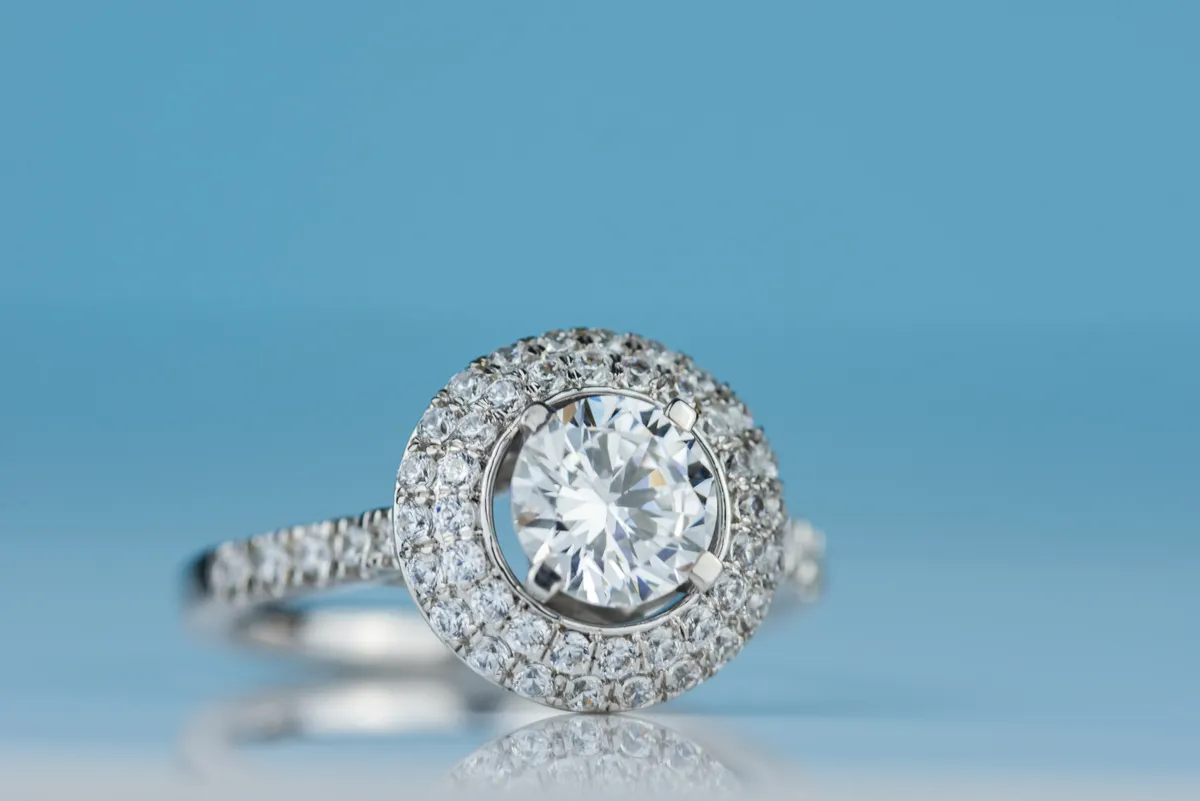
What is a semi-mount engagement ring?
A semi-mount engagement ring is a ring setting sold without its center stone. The band, prongs or center-stone head, and decorative details are already designed; accent diamonds may also be included. You then choose a loose diamond or gemstone that fits the setting’s shape, dimensions, and structural requirements.
This approach gives you more control than buying a finished engagement ring. Instead of accepting a center stone already paired with a setting, you can compare stones by cut, carat weight, color, clarity, origin, appearance, and price before the final ring is assembled.
At Hannoush Jewelers, couples can compare semi-mount engagement ring settings and loose diamonds with help from a jeweler at our Albany, Clifton Park, and Queensbury, New York showrooms.
Quick answer: Choose a semi-mount if you want an established ring design but prefer to select the center stone separately. It offers more personalization than a finished ring without requiring a completely original custom design.
What comes with a semi-mount ring?
A semi-mount normally includes:
- The ring shank or band
- The center-stone head, basket, bezel, or prong structure
- Design details such as a halo, cathedral shoulders, milgrain, engraving, or pavé
- Any accent diamonds or gemstones specified in the product description
The center stone is not included unless the listing explicitly says otherwise. Because terminology and included components can vary by designer, confirm exactly what is included before comparing prices.
A jeweler should also verify that your preferred center stone is compatible with the setting. Shape and carat weight are useful starting points, but the stone’s precise length, width, depth, girdle, and overall proportions determine whether it can be set securely and look balanced in the finished ring.
Semi-mount vs. finished vs. custom engagement rings
These three buying paths offer different levels of control:
| Ring type | What you choose | Best for | What to consider |
|---|---|---|---|
| Finished engagement ring | A setting and center stone that are already paired | A simpler, faster purchase with fewer decisions | Less control over the exact center stone |
| Semi-mount engagement ring | An existing setting design plus a separately selected center stone | Buyers who want design choice and diamond control | The stone and setting must be professionally matched |
| Custom engagement ring | The design, materials, dimensions, and center stone | A one-of-a-kind idea or a stone with unusual requirements | Usually requires more design decisions and production time |
A semi-mount occupies the middle ground. The designer has already established the ring’s visual identity, but the most prominent stone remains your choice. For many couples, that provides the most valuable parts of customization without starting from a blank page.
If you prefer a ring that is already assembled, browse Hannoush Jewelers’ finished engagement rings. If your vision requires a fully original design, learn more about building your dream ring.
Who should consider a semi-mount engagement ring?
A semi-mount may be the right choice if:
You want to select the exact center stone
Two diamonds with similar grading reports can look different in person. Choosing the center stone separately allows you to compare light performance, shape, proportions, visible inclusions, color, and overall character before making a decision.
You already own a diamond or gemstone
An heirloom stone, an upgraded diamond, or a loose stone purchased earlier may be suitable for a semi-mount. The stone should be inspected first for damage, wear, previous repair work, and compatibility with the new setting. Some settings can be ordered or adapted for a particular stone; others cannot be modified safely or attractively.
You want more control over the budget
Separating the setting and center stone makes the tradeoffs easier to see. You may prefer a simpler setting and devote more of the budget to cut quality or carat weight. Another buyer may choose a detailed designer setting and select a center stone that keeps the total within range.
A semi-mount is not automatically less expensive than a finished ring. Its advantage is budget control, not guaranteed savings.
You want a designer look with personal input
Semi-mounts are available in many established styles, including solitaires, halos, three-stone rings, pavé bands, split shanks, and sculpted settings. You retain the designer’s proportions and details while choosing the stone that becomes the focal point.
You want to reset a meaningful stone
A new setting can give an inherited diamond a more current look while preserving its history. Before selecting a mount, have the stone measured and evaluated. The safest design is one chosen around the stone’s actual condition—not only its stated carat weight.
How to build a semi-mount engagement ring
1. Choose the setting style
Begin with the overall look your partner is most likely to love. Consider:
- Solitaire: keeps attention on the center stone
- Halo: creates a larger visual footprint with surrounding accent stones
- Three-stone: adds side stones and symbolic appeal
- Pavé or channel-set band: brings additional sparkle across the ring
- Cathedral or sculpted profile: adds height and architectural detail
Think beyond the top-down view. The profile affects how high the center stone sits, whether a wedding band will rest flush, how easily the ring may catch on clothing, and how practical it feels for everyday wear.
Use Hannoush Jewelers’ ring setting guide to compare common styles, then browse the semi-mount collection.
2. Select the metal
Common options include platinum and 14K or 18K gold in white, yellow, or rose tones. Each creates a different appearance and ownership experience.
- Platinum is naturally white, dense, and durable. It develops a soft patina over time and is often chosen for prongs and heirloom-quality settings.
- White gold offers a bright white appearance but may need periodic replating, depending on its finish and wear.
- Yellow gold provides a warm, classic contrast and can complement diamonds across a wider range of color grades.
- Rose gold has a warm blush tone that makes the setting itself a strong design feature.
Metal choice should account for appearance, maintenance, skin sensitivity, lifestyle, and budget. Hannoush Jewelers’ metals education guide explains the practical differences in more detail.
3. Choose the center-stone shape
The setting may be designed for one shape or available in several center configurations. Popular choices include round, oval, cushion, princess, emerald, pear, marquise, and radiant cuts.
Shape affects more than style. It influences apparent size, finger coverage, brilliance, prong placement, and how easily the stone can be protected. Elongated shapes can create more visual length, while pointed shapes such as pear and marquise cuts usually need protective prongs at vulnerable tips.
If you are comparing silhouettes, start with this guide to choosing a diamond shape.
4. Compare loose diamonds by appearance and documentation
Once the setting direction is clear, compare loose diamonds that fit the design and budget. Review the following:
- Cut and light performance. For round brilliant diamonds, the report’s cut grade is an important screening tool. For fancy shapes, compare brightness, contrast, symmetry, and any dark or watery-looking areas in person.
- Dimensions and proportions. Millimeter measurements determine physical fit and influence how large the diamond appears.
- Color and clarity. Decide what is visibly important in the chosen shape and metal rather than paying for grades you cannot appreciate without magnification.
- Independent grading report. Review the report from a reputable independent laboratory, such as GIA or IGI, and confirm that its number matches the stone.
- Natural or lab-grown origin. Both are diamonds. They differ in origin, rarity, pricing, and resale considerations—not in the basic requirements for secure setting and everyday care.
- In-person appearance. View the finalists under more than one lighting condition and compare them side by side when possible.
For more background, explore Hannoush Jewelers’ guides to the 4 Cs of diamonds, lab-grown vs. natural diamonds, and the benefits of buying a loose diamond.
5. Have the stone and setting evaluated together
Do not assume that any stone of the advertised shape and carat weight will fit. A jeweler should check:
- The stone’s exact length, width, and depth
- The center setting’s supported shape and size range
- Prong position and coverage
- Clearance above halos, side stones, or structural details
- Overall balance and wedding-band compatibility
- Any risks created by an heirloom stone’s wear or previous damage
If the pairing is not safe or visually balanced, the better solution may be a different mount, a different center stone, a replacement head, or a fully custom setting.
6. Review the completed ring
Before taking the ring home:
- Confirm that the center stone sits level and centered
- Check that every prong makes secure, even contact
- Look for gaps, looseness, or distracting asymmetry
- Confirm the ring size and whether a future resize could affect the design
- Ask about care, inspection, warranty, appraisal, and service policies
- Review insurance options for the complete ring, not just the center stone
Production time depends on designer availability, metal, sizing, center-stone requirements, and whether the setting must be ordered or modified. Ask for a written timeline before planning a proposal date, and account for sizing, insurance, and any follow-up service the ring may need.
Questions to ask before buying a semi-mount
Bring these questions to your appointment:
- Is the displayed price for the setting only?
- Are the accent diamonds or gemstones included?
- Which center-stone shapes and millimeter ranges can this design support?
- Can this exact setting be ordered for my preferred stone?
- Will the ring sit flush with a wedding band?
- How will changing the center-stone size affect the ring’s proportions?
- Is resizing possible after the ring is completed?
- What production timeline should I expect?
- What inspection, maintenance, warranty, return, and exchange terms apply?
- Will I receive documentation for the center stone and the completed ring?
Clear answers make it easier to compare options on total value rather than the setting’s starting price alone.
Frequently asked questions
Is a semi-mount engagement ring cheaper than a finished ring?
Not necessarily. The final price combines the setting, center stone, sizing, setting labor, and any customization or service charges. A semi-mount gives you more control over how the total budget is allocated, but it does not guarantee a lower price.
Does a semi-mount include the small diamonds on the band or halo?
Often, yes. Many semi-mounts include the accent stones shown in the design while leaving only the center position empty. Inclusions vary, so check the product description and written quote before purchasing.
Can any diamond fit any semi-mount?
No. The center stone must be compatible with the setting’s shape, millimeter dimensions, depth, prong layout, and structure. Some semi-mounts can be ordered or adjusted for a particular stone, while others support only a defined size and shape range.
Can I use an heirloom diamond in a semi-mount?
Often, but the diamond should be inspected and measured first. A jeweler needs to confirm that the stone is in suitable condition and that the new setting will protect it securely. Chips, abrasions, unusual proportions, or previous repairs may limit the safest options.
Can I use a colored gemstone instead of a diamond?
Possibly. The gemstone must fit the setting, and its durability should suit the intended frequency of wear. Some gems need more protective setting styles than diamonds. Have a jeweler evaluate the specific stone rather than choosing by carat weight alone.
How long does a semi-mount engagement ring take to complete?
The timeline varies by designer availability, metal, ring size, center-stone fit, and required customization. A stock setting with a compatible stone may be completed sooner than a special-order or modified design. Confirm the current estimate before setting a proposal date.
Is a semi-mount the same as a setting?
The terms are sometimes used interchangeably, but “semi-mount” usually describes a largely finished ring that lacks its center stone. A general “setting” may refer to the whole ring design or only the structure that secures a gemstone. Confirm what the seller includes rather than relying on the label alone.
Build your semi-mount engagement ring at Hannoush Jewelers
The best semi-mount is not simply the most attractive setting or the highest-graded diamond. It is the combination that looks balanced, protects the center stone, suits the wearer’s routine, and uses the budget where it matters most.
At Hannoush Jewelers, you can compare designer semi-mounts with natural and lab-grown loose diamonds in one appointment. Our team can help you review proportions, verify compatibility, compare stones in person, and understand the full cost and timeline before the ring is completed.
Schedule an appointment at our Albany, Clifton Park, or Queensbury showroom. If you prefer to divide the purchase into payments, review the available financing options.